PULSESIGMA-WHERE HEALTHCARE MEETS FINANCIAL PRECISION
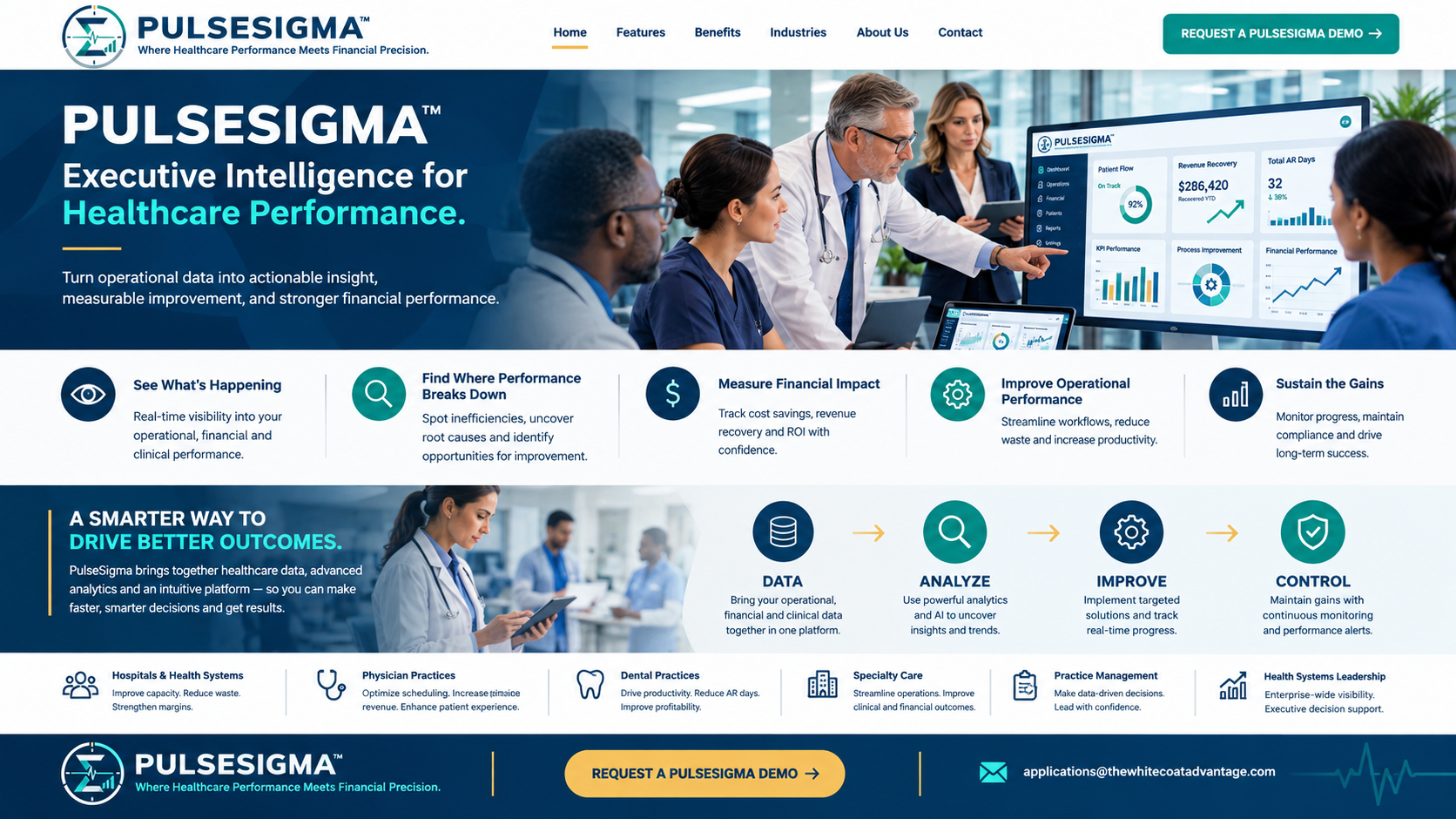
FEATURES
DMAIC-Native Structure
Every function in PULSESIGMA maps to a phase of the Six Sigma improvement cycle: Define, Measure, Analyze, Improve, Control. Each workpaper produces auditable evidence of compliance with ISO 13053 Part 1 and Part 2, not a spreadsheet you have to defend in an audit.
Denial and Rework Analytics
Isolates where revenue actually leaks: denials by payer, provider, location, and category; first-pass submission performance; rework and correction activity; charge lag and days in A/R. It separates repeat patterns from one-offs so you fix the cause, not the symptom.
Cost of Poor Quality Engine
Converts process defects into dollars across four financial consequences: rework labor cost, lost capacity, denial exposure, and recoverable cash. Process waste stops being an abstraction and becomes a line on the operating statement.
Configurable Loaded Labor Cost
Labor cost is configured by role, department, and location: base rate, burden, benefits, and allocation factors, each with an effective date. No universal wage assumption is applied to your organization. Every estimate traces to the rate behind it.
A Statistical Toolkit Built for Healthcare Workflows
Pareto and cost-weighted Pareto analysis, run charts, histograms, boxplots, heatmaps, and control charts, selected because they apply to revenue-cycle and operational data. Manufacturing artifacts stay out. Statistical power never outruns the user’s ability to interpret it.
Full Traceability
Every displayed figure resolves to its source data, its calculation method, the benchmark it was measured against, and the status of that underlying data. Any number PULSESIGMA shows you, you can defend.
AWAITING DATA, Never a False Zero
When a required value is missing, PULSESIGMA reports AWAITING DATA. It does not treat a blank as zero, and it does not render a missing measure as a red result. An unmeasured process is not a process without cost. It is a process waiting to be measured.
Standard Work and Metric Ownership
Each metric carries a named owner and a documented escalation path. Standard work is written down, so the improvement survives staff turnover instead of leaving with the person who designed it.
Executive Dashboard and Visual Scorecard
Leadership reads the whole revenue cycle at a glance, with configured thresholds and status indicators. The Executive Dashboard stays executive-level; the Visual Scorecard carries the analytical charts.
Sits Alongside Your Systems
PULSESIGMA does not replace your EHR, practice management, billing, clearinghouse, or payroll systems. It reads exported operational and revenue-cycle data and answers the question those systems were never built to answer: what is this process costing us, and did the correction work?
Three Editions
LITE for independent physicians, dentists, and single-location practices. STANDARD for multi-provider organizations with dedicated billing and RCM teams. ENTERPRISE for health systems and corporate healthcare entities. The data model carries forward. You never start over.
BENEFITS:
You can defend the number.
Not “the dashboard says so.” Every figure carries its source, its method, and its data status. When a CFO, a board, or a payer asks where a number came from, the answer exists.
You stop optimizing the wrong thing.
Most practices can name their biggest frustration. Few can name their biggest cost. PULSESIGMA weighs defects by dollar impact, so improvement effort lands where the money is.
You find revenue that is already inside your process.
Denials never resubmitted. Claims under-coded. Capacity lost to waiting. Labor consumed by duplicate data entry. None of it appears as a line item. It spreads across the operating statement until it reads as normal. PULSESIGMA names it and sizes it.
You know what you don’t know.
AWAITING DATA tells you where measurement is missing rather than filling the gap with an assumption. That distinction is the difference between a decision and a guess.
The improvement holds.
The Control phase isn’t a formality. Ownership, standard work, and drift flags mean the gain is protected after the project closes, not discovered again in eighteen months.
Your process knowledge survives your people.
Standard work documentation outlives the manager, the analyst, and the consultant.
You get a defensible compliance posture.
ISO 13053 alignment is structural, and the MSA gate enforces measurement validation before you baseline. The audit trail is generated as you work, not reconstructed later.
Measurement finds the gap. Capital funds the fix.
PULSESIGMA identifies and sizes the opportunity. AR-Backed Working Capital provides liquidity against revenue already earned, lending against the aggregate sum of monies due across total receivables. Equipment leasing funds imaging, diagnostics, and AI-enabled tools on a usage basis. When the analysis identifies a fix worth making, financing doesn’t have to wait for the next budget cycle.
It works with what you already own.
No rip-and-replace. No live integration project. Export the data your systems already produce and start measuring.
INDUSTRIES SERVED:
Why healthcare should choose White Coat Financial Partners for their Six Sigma needs? We only do healthcare. That is the entire argument.
Six Sigma was born on the factory floor, and most firms still deliver it that way. Their practitioners arrive with playbooks built for assembly lines, then spend the first month of an engagement learning why those playbooks don’t fit a medical practice. You pay for that learning curve.We never had to learn it. Ambulatory healthcare is the only industry we serve. Our analytics are built for NAICS 6211, and our benchmarks come from MGMA and RMA rather than generalized cross-industry data.
We speak the language of your revenue cycle, not the language of manufacturing.
Denials. First-pass yield. Clean claim rate. Days in A/R. Charge lag. Payer mix. Case mix. Prior authorization. These are the defect categories we measure because these are the defects that cost healthcare organizations money. We don’t translate your problems into manufacturing analogies. We start from your problems.
We know the failure modes that generalists don’t.
Healthcare data breaks statistical tools in specific ways. Patient satisfaction arrives as bounded ordinal survey data. Apply a capability index to it and you get a mathematically valid, completely meaningless result. Adverse events and readmissions are rare events that require rare-event control charts, never a Cpk. Generalist consultancies misapply these tools routinely, and the outputs look authoritative while being wrong. Recognizing the difference is not a detail to us. It is the discipline.
We bring the analysis, the capital, and the accountability to the same table.
Most improvement firms hand you a recommendation and leave the funding problem to you. Most lenders fund without measuring. We do both. Our Lean Six Sigma practice identifies and sizes the opportunity; our AR-Backed Working Capital and equipment leasing structures fund the fix. One relationship, one view of the numbers, and no gap between what the analysis recommends and what the balance sheet will support.
We built the tool instead of borrowing one.
PULSESIGMA is our own Windows application, developed from real revenue-cycle and operational improvement work, not a reskinned generic statistics package. It is designed by practitioners who have sat in the operating reviews and answered for the numbers.
We respect the boundary around patient data.
PULSESIGMA analyzes exported operational and revenue-cycle data. It is not built to process protected health information, and we do not ask you to move PHI to use it. The measurement layer and the clinical record stay separate by design.
We measure, then we commit.
Any firm can promise improvement. Our position is narrower and harder: we will show you the baseline, name the root cause, size the financial impact, and tell you plainly where your data is insufficient to conclude anything. When PULSESIGMA reports AWAITING DATA, that is not a limitation. That is the tool refusing to hand you a number it cannot stand behind.
That is why healthcare organizations choose us. Not because we claim to know healthcare better than anyone, it’s because healthcare is the only thing we do.